
Building Our Way Out
Why Canada Isn't Building Enough Housing — and What Would Change That
A research paper by Calnan Real Estate Group
June 2026
Canada has the fewest homes per person in the G7. That fact is not recent, and no turn of events in the last few years created it — it is a structural condition, built over decades, that has endured through boom and bust alike. Understanding it requires a question most of the housing debate does not ask: not why housing is needed, but why housing does not get built.
The answer comes down to arithmetic. A developer does not build because homes are needed. A developer builds when a finished project will be worth more than it costs to create, by a margin wide enough to justify years of risk and committed capital. That margin has been squeezed until viable projects quietly become unviable across much of the country. This is the central finding of a new white paper published by Calnan Real Estate Group: Building Our Way Out: A Practical Framework for Solving Canada's Housing Crisis Through Supply, Innovation and Partnership.
The Project, Not the Need
“A housing shortage can persist even when everyone wants more housing,” the paper states, “because it is the project — not the need — that has to add up.”
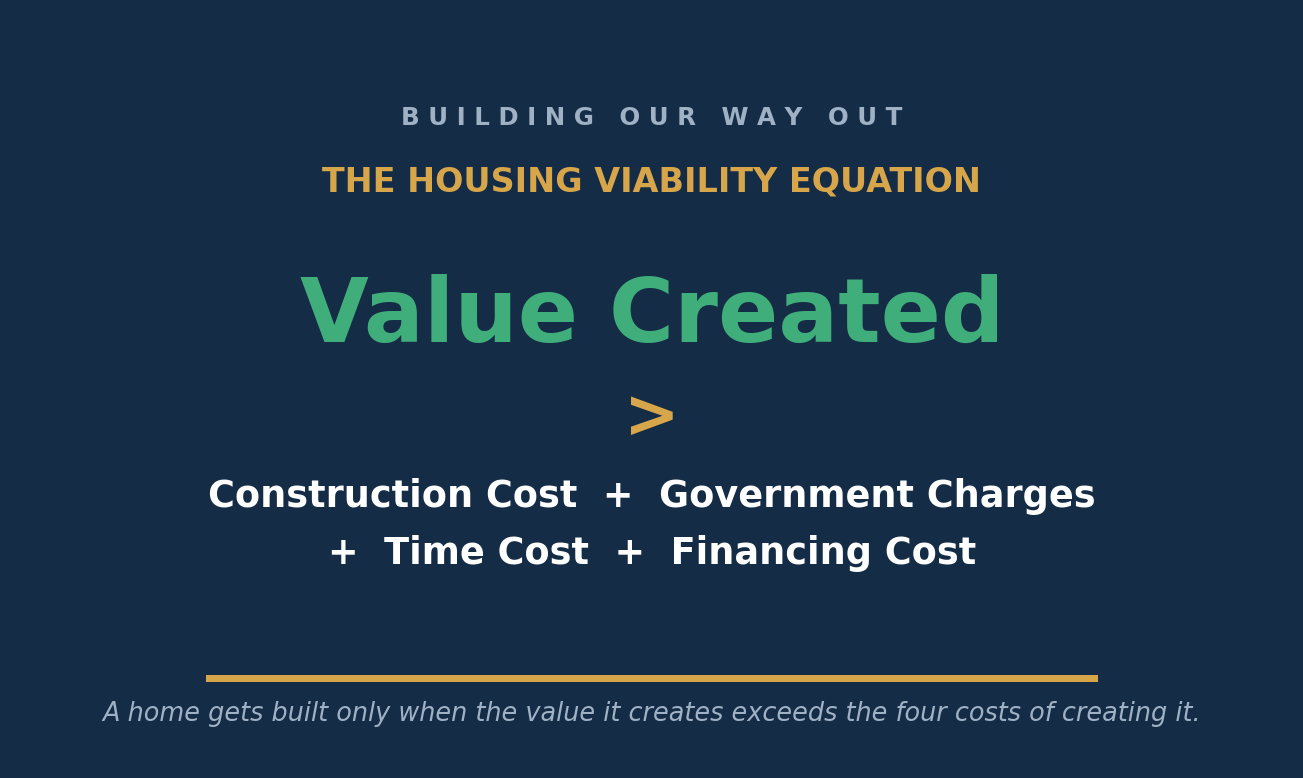
The paper introduces a framework called the Housing Viability Equation:
Value Created > Construction Cost + Government Charges + Time Cost + Financing Cost
A home is built only when the value it creates exceeds these four costs. When the right-hand side wins, the project dies and the home is never built. Three of those four costs are set largely by government — which is both the problem and the opportunity.
To make the principle concrete, CREG modelled two representative 100-unit projects — a purpose-built rental building and a condominium — under current Western Canadian conditions. The results are decisive:
- —A ten per cent rise in construction costs kills an otherwise-viable project.
- —Development charges at Toronto levels erase a condominium's entire margin.
- —Stretching approvals from six months to two years flips both projects from viable to dead.
- —New purpose-built rental does not pencil at market rents. CMHC financing is usually the difference between a rental building getting built and not getting built. Strip it away, and the required rent jumps by roughly a third.
These are not edge cases. They are the current operating environment in a large share of the country.
The Geography of Housing Is Upside Down
One of the paper's sharpest findings concerns geography. “Housing is easiest to build where the pressure is lowest, and hardest where the need is greatest,” it concludes.
In Alberta — faster approvals, lower development charges, available land — new housing pencils. Calgary delivered roughly 7,000 purpose-built rental units in 2024, more than double its historical average. Edmonton legalized up to eight units per lot city-wide and saw “missing middle” construction double in a year. The Alberta experience is not about Alberta's demand, which has been fierce — the province led national net interprovincial migration for three consecutive years. It is about Alberta's costs, which are a fraction of those in the constrained coastal cities.
In Toronto and Metro Vancouver, where demand is the most intense in Canada, the cost-and-time stack is so heavy that private rental cannot pencil at all. The approval process alone adds on the order of $229,000 to the cost of a home in Canada's eight most restrictive cities — and roughly $600,000 in Vancouver. The failure is not one of demand or willingness to build. It is one of economics.
What Would Actually Work
The paper is direct about what the evidence supports — and what it doesn't.
The measures most likely to materially increase supply by 2035, ranked:
- 1.As-of-right zoning with statutory approval timelines, entrenched in provincial law.
- 2.Development-charge reform paired with senior-government infrastructure funding.
- 3.Stable, better-targeted CMHC rental financing.
- 4.Financed industrialized construction, for its time savings.
- 5.A genuine non-market housing tier for the lowest incomes, plus fair-conduct rules for large landlords.
- 6.A deliberate role for capable secondary markets.
The paper is equally clear about what will not work. Demand-side buyer subsidies, foreign-buyer bans, and speculation taxes have the weakest record in the kit. “They have a constituency, not a record,” the paper states. Announcing housing targets without changing approvals, charges, financing, or productivity does not build homes.
On CMHC, the paper takes a position: it is “essential and imperfect — public infrastructure that does something the private market will not.” Dismantling it in the middle of a shortage would remove the instrument currently making rental viable. The right course is to reform it — better-targeted affordability rules, multi-year stability for the industry, and a measure of completed affordable homes rather than dollars committed.
The paper also holds both halves of the housing problem in view. Ownership prices were driven as much by two decades of cheap credit and investment demand as by physical shortage; supply is the most powerful lever for rents and for the structural shortage, but it will not, on its own, unwind a quarter-century of asset inflation. A serious framework leads with supply while treating the asset market seriously.
Three Futures for Canada
The paper maps three scenarios to 2035: status quo (the shortage grinds on as the current reprieve from rents proves temporary); partial reform (measurable improvement in some markets, inadequate nationally); and full reform (completions above 300,000 per year, the structural shortage closes meaningfully, rents stabilize and then ease).
Status Quo
The shortage grinds on. The current reprieve from rents proves temporary.
Partial Reform
Measurable improvement in some markets — inadequate nationally.
Full Reform
Completions above 300,000 per year. The structural shortage closes meaningfully. Rents stabilize and then ease.
“The gap between these futures is not luck or the business cycle. It is a choice.”
Its final line: “Canada's housing crisis is not, at its root, a shortage of demand, of builders, of capital, or of ideas. It is a shortage of viable projects — and that is a shortage we can choose to end.”
About the Paper
Building Our Way Out draws on four phases of primary-source research — CMHC, Statistics Canada, the Parliamentary Budget Officer, the Bank of Canada, the OECD, and peer-reviewed economics — alongside a full development pro-forma model and a 15-case domestic and international case study library. The paper is written for policymakers, public servants, builders, lenders, and the journalists who cover them. It is not a solicitation and does not promote any investment opportunity.
Research Downloads
Building Our Way Out — White Paper
The complete 16-chapter paper — research, analysis, and recommendations. Drawing on primary-source research, a full development pro-forma model, and 15 real-world case studies. (~14,000 words, PDF)
Download (PDF)Building Our Way Out — Executive Brief
One-page summary of key findings and recommendations. Designed for policymakers, industry stakeholders, and anyone who needs the essentials. Suitable for forwarding and printing. (1 page, PDF)
Download (PDF)About the Author
Calnan Real Estate Group is a Western Canadian real estate group active across the housing value chain — multifamily development, purpose-built rental operations, CMHC-insured financing, real estate asset management, and the long-term ownership and operation of residential assets. The paper was prepared by Matt Calnan, CPA, CMA, Managing Director of Calnan Real Estate Group, drawing on direct experience in the markets and project economics the paper examines. Building Our Way Out is a contribution to public policy and industry understanding; it does not promote any product, security, or investment, and nothing in it constitutes an offer or solicitation.
Media Contact
Matt Calnan, CPA, CMA
Managing Director, Calnan Real Estate Group
matt@calnan.coCalnan Real Estate Group is available to comment on Canada's housing supply, development economics, CMHC policy, purpose-built rental, and the Alberta housing market. Background materials, source citations, and additional data from the research package are available to qualified journalists on request.
Speaking Engagements
Calnan Real Estate Group is available for conference presentations, panel discussions, and podcast conversations on Canada's housing supply challenge. Topics include the economics of housing development, CMHC's role in rental viability, the case for approval and development-charge reform, the Alberta housing experience, and what policy changes would most effectively increase supply by 2035. To discuss a speaking engagement, contact matt@calnan.co.
This paper is provided for informational and public policy purposes only. It does not constitute an offer to sell or a solicitation of an offer to buy securities. Nothing in this paper constitutes investment, legal, or tax advice.